Fuel and Fortune: The Invisible Tanker Crews Who Kept America's Air War Over Iraq Alive
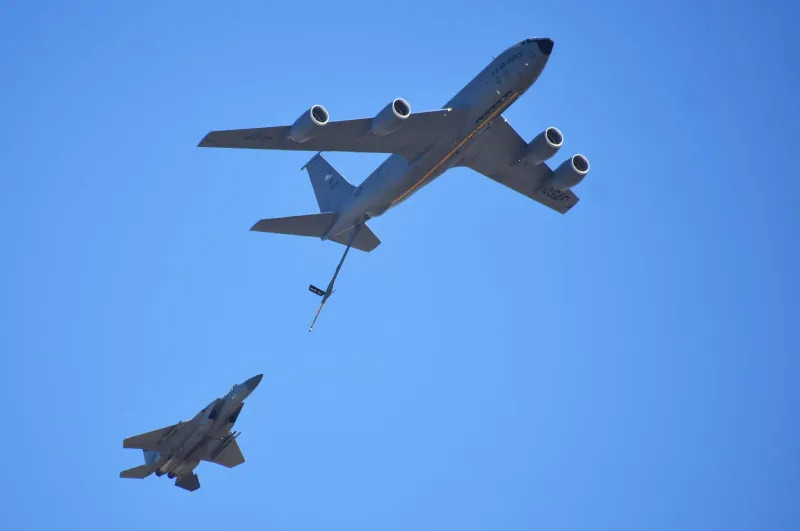
In the popular imagination, air war is defined by the aircraft that drop bombs. The F-16 banking through a target run, the B-52 releasing its payload from altitude, the A-10 strafing a column of armor — these are the images that endure. What rarely enters the frame is the unglamorous, indispensable machinery that made all of it possible: the aerial tanker, orbiting in silence above the desert, waiting to give life to aircraft that would otherwise fall short of their objectives.
For more than three decades, from the opening salvos of Desert Storm in January 1991 through the long counterinsurgency years of Operation Iraqi Freedom and beyond, KC-135 Stratotankers and KC-10 Extenders operated as the circulatory system of American airpower over Iraq. They were, in the words of one retired boom operator, "the gas station that nobody ever talked about."
The Geometry of Endurance
Aerial refueling is, at its core, a logistical problem with lethal consequences when it fails. Aircraft operating from bases in Saudi Arabia, Kuwait, Turkey, Diego Garcia, and eventually forward-positioned airfields in the Gulf region faced a common constraint: the tyranny of distance. Iraqi airspace is not small. A fighter departing a Saudi base for a target in northern Iraq could easily consume the majority of its internal fuel load before reaching the objective area, leaving precious little margin for the engagement itself, let alone the return flight.
The tanker solved this equation, but only when placed correctly. Mission planners during Desert Storm developed what became known as refueling tracks — designated corridors in the airspace where tankers would orbit in predictable patterns, available to thirsty strike packages at pre-planned intervals. These tracks were not improvised. They were the product of meticulous coordination between air operations centers, tanker wing commanders, and the fighter squadron leadership who understood exactly how much fuel their aircraft would need at each phase of a mission.
Declassified Air Force planning documents from the Gulf War period reveal that on peak operational days, as many as 60 tanker sorties were airborne simultaneously over the theater, supporting strike packages that ranged from single-ship reconnaissance flights to massive coordinated raids involving dozens of aircraft. The fuel offloaded during those operations — measured in millions of pounds per day — represented a logistical achievement that rivaled anything seen since the Berlin Airlift.
The KC-135 and KC-10: Two Philosophies in the Air
The workhorses of this effort were two fundamentally different aircraft, each with distinct strengths that planners learned to exploit.
The KC-135 Stratotanker, a derivative of the Boeing 707 airframe and a product of the early Cold War, was the backbone of the tanker fleet. Lean, relatively austere by modern standards, and operated by crews as small as three or four personnel, the KC-135 was designed for endurance and high-altitude efficiency. Its boom system — a rigid, telescoping refueling tube extended by a dedicated boom operator lying prone in the aircraft's tail — could transfer fuel at rates exceeding 1,000 pounds per minute. Over Iraq, Stratotanker crews flew missions that routinely lasted eight to ten hours, orbiting in assigned tracks while the war unfolded below them.
The KC-10 Extender, derived from the DC-10 commercial airliner and introduced to service in the 1980s, brought a different capability. Larger, capable of carrying significantly more fuel, and equipped with both a boom system and a drogue-and-probe system for Navy and allied aircraft, the KC-10 functioned as what tanker crews called a "force multiplier of the force multiplier." A single KC-10 could refuel multiple aircraft types in a single sortie and still carry enough residual fuel to extend its own range considerably. During the early days of Desert Storm, KC-10s operating out of Saudi Arabia were credited with enabling the longest-range strike missions of the campaign, including support for B-52 sorties that originated from bases thousands of miles away.
When the Fuel Runs Short
The consequences of tanker shortfalls were not theoretical. Veteran pilots who flew over Iraq in both the 1991 and 2003 campaigns have described moments of genuine anxiety when a scheduled tanker failed to appear at the rendezvous point — whether due to mechanical problems, airspace conflicts, or the fog of a rapidly evolving operational picture.
One former F-15E Strike Eagle weapons systems officer, speaking in a 2018 interview with an Air Force historical program, described a mission during the early weeks of Iraqi Freedom in which his aircraft arrived at the refueling track to find the assigned KC-135 had been diverted to support an emergency close-air-support request elsewhere in the theater. "We had a decision to make in about thirty seconds," he recalled. "Continue to the target area on what we had and accept a bingo fuel situation on the egress, or abort and reschedule. We continued. It worked out. But it was not a comfortable flight home."
Such moments underscored a truth that senior air commanders had long understood: tanker availability was not a supporting consideration in campaign planning. It was a primary constraint. The number of strike sorties that could be generated on any given day was determined not only by the availability of fighters and weapons, but by the number of tankers that could be positioned, fueled, and crewed to support them.
Strategic Weight in an Unglamorous Role
The tanker community within the Air Force has historically occupied an awkward cultural position. Fighter pilots, whose professional identity is bound up in the kinetic act of aerial combat, have sometimes regarded tanker crews with a mixture of gratitude and condescension — grateful for the fuel, but reluctant to accord the tanker mission the same prestige as the strike mission. This dynamic was not unique to Iraq, but the sheer scale and duration of operations there made it particularly visible.
What that cultural bias obscured was the genuine complexity of the tanker mission. Boom operators — enlisted personnel who guided the refueling boom into the receptacle of a receiving aircraft — worked in demanding conditions, often in turbulence, at night, and under the pressure of a strike package waiting on their precision. A single misalignment during contact could damage both aircraft. Tanker pilots flew long orbits that demanded sustained concentration, managed complex fuel transfer calculations in real time, and coordinated with multiple receiver aircraft across radio frequencies that were frequently congested with operational traffic.
Furthermore, tankers were not invulnerable. During the Gulf War, Iraqi surface-to-air missile systems posed a theoretical threat to tanker tracks positioned too close to defended airspace. Mission planners worked to keep tanker orbits outside the engagement envelopes of known Iraqi air defense systems, but the margin was not always comfortable. The tanker was a high-value, difficult-to-replace asset, and its loss would have cascaded through the entire operational schedule in ways that a single fighter loss would not.
A Legacy Written in Pounds of Fuel
The full accounting of what aerial refueling contributed to American operations over Iraq across three decades remains scattered across declassified after-action reports, unit histories, and the personal recollections of crews who have since retired. No single monument commemorates their service. No famous callsign has entered the popular lexicon the way that fighter squadron names sometimes have.
What exists instead is a record of sustained, professional competence that enabled everything else. Every precision strike that dismantled Iraqi command infrastructure in 1991, every close-air-support mission that protected American ground forces in 2003 and beyond, every intelligence-gathering flight that mapped the evolving battlefield — all of it was sustained, in whole or in part, by tanker crews who showed up, orbited their assigned tracks, and transferred fuel with the quiet reliability that the mission demanded.
The tanker war over Iraq was not glamorous. It was, however, essential. And in the honest accounting of how American airpower sustained itself across the longest continuous air campaign in the nation's history, the KC-135 and KC-10 crews deserve a place that history has been slow to grant them.