Into the Fire Again: The Combat Search-and-Rescue Crews Who Refused to Leave Anyone Behind in Iraq
In the lexicon of American airpower, certain aircraft earn their reputations through spectacle — the sonic boom of the F-15 pulling off a kill, the deliberate thunder of a B-52 releasing its payload. Combat search-and-rescue, known throughout the military as CSAR, earns nothing through spectacle. Its currency is silence, speed, and the willingness to descend into the worst possible place at the worst possible moment. During Operation Iraqi Freedom and the years of conflict that followed, the crews who flew those missions did so largely without recognition, operating in the shadow of a war that generated far more celebrated stories.
This is an attempt to bring some of those missions into the light.
The Doctrine and the Machine
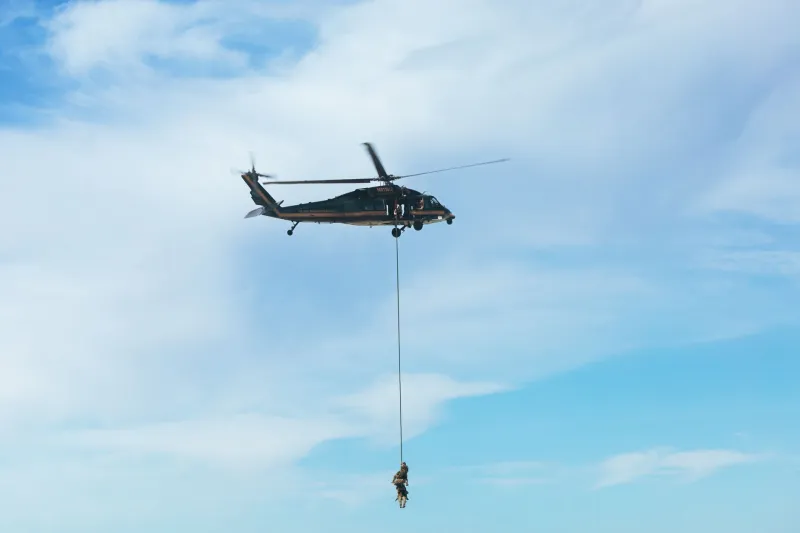
American CSAR doctrine during the Iraq conflict rested on a principle that predates modern aviation: no service member is abandoned on the battlefield. In the aerial context, this obligation fell primarily on the crews of the HH-60G Pave Hawk helicopter — a highly modified variant of the Black Hawk equipped with terrain-following radar, forward-looking infrared sensors, an aerial refueling probe, and defensive systems designed to give it a fighting chance in contested airspace.
The Pave Hawk was not a young aircraft by 2003. Many of the airframes deployed to the region had accumulated substantial flight hours, and the desert environment added mechanical stress that maintenance crews worked around the clock to manage. Yet the helicopter's capabilities, combined with the training of the crews who flew it, made it the linchpin of a rescue system that stretched from Kuwait to the Turkish border.
Supporting those helicopters were fixed-wing assets — HC-130 Combat Shadow tankers that could refuel Pave Hawks in flight, and A-10 Warthog pilots who served as on-call escorts, suppressing ground fire while rescue crews worked below. The coordination required between these elements, often executed under fire and in degraded communications conditions, represented one of the most demanding forms of airmanship in the U.S. inventory.
The First Hours of the War
The opening nights of Iraqi Freedom in March 2003 tested CSAR capabilities almost immediately. As coalition aircraft struck targets across Iraq in the initial air campaign, the potential for downed aircrew multiplied with every sortie. CSAR alert crews — pilots and pararescuemen who slept in flight suits and could be airborne within minutes — maintained continuous readiness at forward operating locations whose names remain partially classified.
The pararescuemen, known universally as PJs, occupied a unique position in this system. Trained as both combat swimmers and emergency medical technicians, they were the individuals who would actually exit the helicopter and reach a downed pilot under fire. Their selection process rivals any in the U.S. military for attrition rate and physical demand. In Iraq, they operated in environments for which no training scenario could fully prepare them — urban rubble, open desert, and everything in between, often at night, often while taking fire.
Accounts from PJs who served in Iraq describe a psychological discipline that went beyond physical courage. "You don't think about what could happen to you," one pararescueman told a military oral historian in 2006. "You think about the job. You think about the guy on the ground. Everything else has to go somewhere else in your head."
Specific Missions, Specific Costs
Several CSAR missions during Iraqi Freedom have been partially documented in military records and veteran accounts, though full operational details remain restricted in many cases.
One widely referenced incident involved the recovery of a coalition aviator whose aircraft went down in the Tigris River valley during the early weeks of the campaign. The rescue required two Pave Hawk crews to coordinate with A-10 escorts in a running suppression effort against small-arms fire from multiple directions while a PJ reached the survivor in standing water under darkness. The entire extraction took less than twelve minutes from touchdown to departure. The mission was considered a textbook execution. It was also, by the account of the crew commander, among the most frightening experiences of his career.
Other missions were less clean. At least two CSAR attempts during the conflict were aborted after ground fire rendered the approach corridor untenable, forcing crews to hold at distance while other assets worked to suppress the threat. The psychological weight of those aborted attempts — of circling above a position where someone needed help and being unable to descend — was described by multiple veterans as one of the most difficult experiences they carried home.
Training That Builds the Will
The preparation that enabled these crews to function under such conditions was neither accidental nor brief. Pave Hawk pilots assigned to CSAR duties completed training pipelines that emphasized low-level night flight, formation flying in degraded visibility, and integration with ground forces — the last of these growing significantly in emphasis after early experiences in Afghanistan demonstrated how frequently CSAR operations intersected with special operations activity.
The joint personnel recovery community, which oversees CSAR doctrine across the services, refined its training continuously throughout the Iraq conflict, incorporating lessons from each mission into subsequent instruction. This iterative process — often invisible to outside observers — was one of the primary reasons that American CSAR capability improved measurably between 2003 and the later years of Operation Iraqi Freedom.
The Weight They Carried Home
No honest account of CSAR operations in Iraq can ignore the psychological dimension. The crews who flew these missions experienced a particular form of stress that differed in character from that of strike pilots or even ground forces. Their purpose was singular and deeply personal — to recover specific individuals — and the gap between that purpose and the hostile environment in which it had to be pursued created psychological pressures that standard combat stress models did not always capture.
Several CSAR veterans have spoken publicly about the difficulty of transitioning out of the operational mindset after deployment. The hypervigilance that made them effective in Iraq — the constant threat assessment, the reflex to plan for the worst — did not simply switch off at home. The Veterans Affairs system, they note, was not always equipped to understand the specific contours of what they had experienced.
A Debt Rarely Acknowledged
The airmen and women who flew combat search-and-rescue missions over Iraq will not be remembered in the same breath as the fighter pilots who dominated the air campaign or the bomber crews who struck high-value targets. Their operations generated no dramatic gun camera footage, no iconic images. What they generated was, in the most direct possible sense, life — the continued existence of men and women who would otherwise have been lost.
That is a legacy worth examining with the seriousness it deserves. The crews who flew into the fire, again and again, asking nothing more than the chance to bring their people home, represent something essential about American military culture at its best. Wings Over Iraq is committed to ensuring their story does not remain untold.