Low and Lethal: The Apache Gunship Pilots Who Fought Iraq's Forgotten Air War
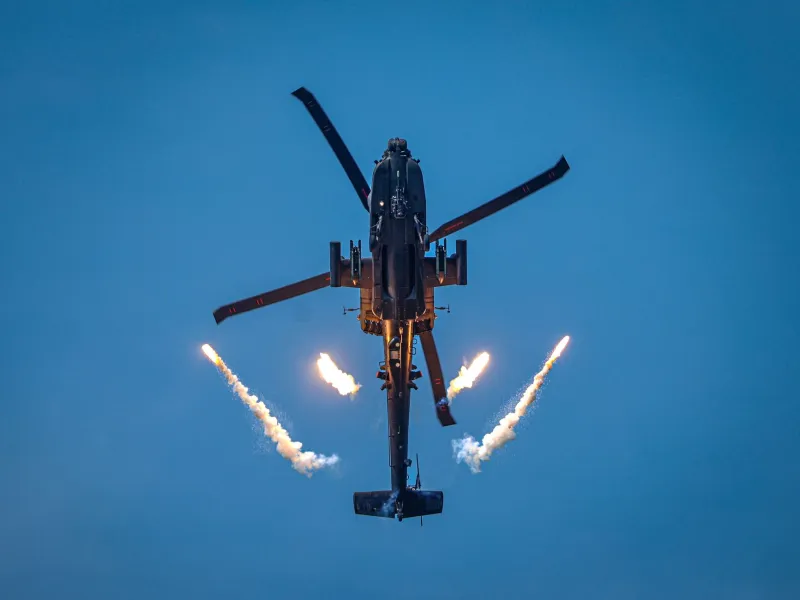
While stealth bombers and carrier jets dominated the headlines of the Iraq air campaign, a different kind of aviator was fighting a far more intimate war just above the rooftops. Apache gunship pilots flew into the teeth of ground fire, insurgent ambushes, and complex urban terrain — and the story of what they accomplished has been largely absent from the official record. Until now.
The Other Air War
Conventional accounts of aerial operations in Iraq tend to follow a predictable arc: the opening salvos of cruise missiles, the suppression of Iraqi air defenses, the carrier air wings sweeping north from the Persian Gulf. These are compelling stories, and they deserve the attention they have received. But they represent only one layer of a conflict that was, in its totality, a three-dimensional battle fought at every altitude from zero feet to the stratosphere.
At the lowest and most dangerous end of that spectrum flew the crews of the AH-64 Apache — attack helicopter pilots and copilot-gunners who operated in an environment where the margin for error was measured not in miles but in meters, and where the enemy could engage with weapons as simple as a rifle and as sophisticated as a radar-guided surface-to-air missile.
Their war was different in almost every respect from the experience of their fixed-wing counterparts. It was slower, closer, louder, and in many ways more psychologically demanding. It was also, by any objective measure, indispensable to the success of American ground operations across the entire arc of the conflict.
Anatomy of an Attack Helicopter Crew
Understanding what Apache crews accomplished in Iraq requires understanding the machine they flew and the unusual dynamic of the two-person crew that operated it.
The AH-64D Apache Longbow — the variant that served as the primary Army attack helicopter throughout the Iraq conflict — is not a subtle aircraft. It is 58 feet long, weighs nearly 17,000 pounds fully loaded, and generates a sound signature that can be detected from considerable distance under the right atmospheric conditions. Its armament includes a 30mm chain gun capable of firing 625 rounds per minute, Hydra 70 unguided rockets, and up to sixteen Hellfire anti-armor missiles guided by either laser or millimeter-wave radar.
The Longbow designation refers specifically to the mast-mounted fire control radar — a dome-shaped sensor array perched above the main rotor that allows the crew to detect, classify, and engage targets while the aircraft remains concealed behind terrain features. In the flat, open desert of central Iraq, this capability was transformative. An Apache crew could rise momentarily above a ridgeline or a berm, acquire targets with the Longbow radar, and engage with Hellfires while remaining largely protected from direct fire.
In urban environments — Fallujah, Mosul, Sadr City — the geometry was far less forgiving.
March 2003: The Opening Assault and Its Hard Lessons
The Apache's most scrutinized moment in the Iraq conflict came on the night of March 23-24, 2003, when a battalion of AH-64s from the 11th Aviation Regiment launched a deep attack mission against Republican Guard armored formations positioned south of Baghdad near Karbala.
What followed became one of the most analyzed episodes in Army aviation history. Iraqi defenders, apparently forewarned of the attack, extinguished lights across a wide area and then illuminated the approaching helicopters with small arms fire coordinated across multiple positions. The Apaches flew into a wall of ground fire. Every aircraft in the assault force sustained battle damage. One was shot down and its crew captured. The mission was aborted.
The Army's subsequent investigation identified failures in mission planning, intelligence preparation, and the fundamental challenge of conducting deep attack operations against a dispersed, prepared enemy in an era when the element of surprise was increasingly difficult to achieve. The lessons absorbed from that night reshaped how the Army employed attack helicopters for the remainder of the conflict — shifting emphasis from deep independent strikes toward close integration with ground maneuver forces.
"Karbala changed everything about how we thought about the Apache's role," said Chief Warrant Officer 4 Marcus Ellingsworth, a veteran of multiple Iraq deployments who now teaches at the Army's Aviation Center of Excellence at Fort Novosel, Alabama. "We stopped thinking of it as a strategic deep attack platform and started thinking of it as the most capable close combat system the Army had ever put in the air. And honestly, that's where it belongs."
The Close Fight: Sadr City and the Urban Crucible
If the Karbala assault represented the Apache's most painful early lesson, the battles in Sadr City during the spring of 2004 and again in 2008 demonstrated what the platform could achieve when employed with appropriate tactical discipline.
Sadr City — a densely populated district of northeastern Baghdad home to more than two million residents — became the primary operating area for Muqtada al-Sadr's Mahdi Army militia during multiple phases of the conflict. The urban terrain presented attack helicopter crews with challenges that no training exercise had fully replicated: buildings that masked targets and restricted engagement angles, civilian populations that complicated rules of engagement, and an enemy that had learned to use the urban environment to negate American technological advantages.
Apache crews responded with adaptations that were as much doctrinal as they were technical. Crews developed refined procedures for coordinating with ground forces in real time, using the aircraft's FLIR (Forward Looking Infrared) sensor to track individual combatants through alleyways and across rooftops while maintaining continuous radio contact with the soldiers below. The 30mm gun — accurate enough at close range to engage a single individual in a crowd — became the weapon of choice in environments where the blast radius of a Hellfire missile created unacceptable risks of civilian casualties.
Pilot Chief Warrant Officer 3 Sandra Reyes, who flew 187 combat hours over Baghdad between 2007 and 2008, described the cognitive demands of these missions in terms that illuminate the gap between the clinical language of official reports and the lived reality of low-altitude combat.
"You're processing about fifteen different information streams simultaneously," she explained during a 2021 oral history interview. "You've got the radio calls from the ground, the sensor picture in your monocle, the threat warnings in your ear, the aircraft systems — and you're making decisions that have irreversible consequences in a matter of seconds. The machine helps you manage all of that, but in the end it comes down to judgment. Human judgment, under conditions that human beings weren't really designed to operate in."
Maintenance, Attrition, and the Soldiers Who Kept Them Flying
Any honest account of the Apache's performance in Iraq must acknowledge the extraordinary effort required to sustain a fleet of complex, battle-damaged aircraft through years of continuous combat operations. Attack helicopter maintenance is a labor-intensive endeavor under peacetime conditions; in a combat zone, with aircraft returning from missions with bullet holes, shrapnel damage, and sand-contaminated systems, the demands placed on maintenance crews were staggering.
Army aviation maintenance units routinely worked around the clock to return aircraft to flight status, cannibalizing parts from non-mission-capable airframes, improvising repairs with whatever materials were available, and developing field-expedient solutions to problems that the aircraft's designers had never anticipated. Their contribution to the Apache's operational record in Iraq is inseparable from the achievements of the crews who flew the missions.
What the Record Shows
The aggregate statistical record of Apache operations in Iraq — while not fully declassified — supports a conclusion that the platform's contributions to the conflict were both substantial and underappreciated in the broader public narrative. Army aviation units flying AH-64s were credited with thousands of close air support missions, the destruction of significant quantities of enemy armor and crew-served weapons, and the direct support of ground force operations across every major phase of the conflict.
More importantly, Apache crews developed and refined a set of tactics, techniques, and procedures for urban attack helicopter operations that did not exist when the conflict began. Those lessons — written in the operational records of units from Fort Campbell, Fort Hood, and Hunter Army Airfield, and in the memories of the men and women who flew the missions — constitute a body of institutional knowledge that continues to shape Army aviation doctrine.
The fixed-wing aviators who flew above them will always command a certain kind of attention. The speed, the altitude, the technological spectacle of precision bombing from the stratosphere carries an inherent drama that the low, grinding work of the attack helicopter cannot easily replicate in the popular imagination. But among those who study the actual conduct of the Iraq air campaign — mission by mission, engagement by engagement — the Apache crews occupy a place that history has not yet fully honored.