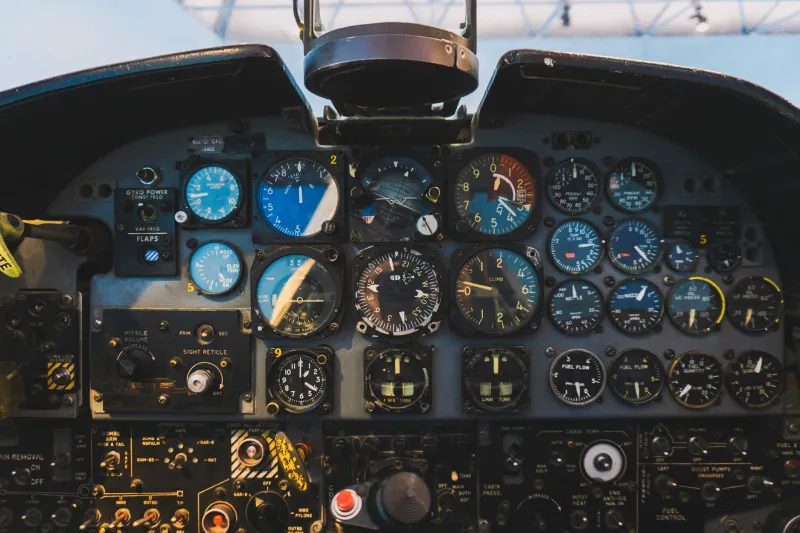
Voices From the Losing Side: Iraqi Fighter Pilots Speak on Defeat, Adaptation, and the Weight of an Unwinnable War
Photo: Nachoom Assis, CC BY-SA 4.0, via Wikimedia Commons
They flew Soviet-built jets against an adversary that had spent decades engineering their obsolescence. Now, in measured and often painful interviews, surviving Iraqi fighter pilots offer something rarer than tactical analysis: an honest account of what it means to enter a cockpit knowing the outcome has already been decided—and how that knowledge reshapes a man long after the engines go quiet. Their testimonies, gathered across more than a decade of careful contact with researchers, journalists, and former adversaries, constitute one of the most psychologically revealing oral histories to emerge from any modern air campaign.
The Architecture of Asymmetry
To understand what these pilots endured, it is necessary to understand the environment in which they operated. By the time of Operation Desert Storm in 1991, the Iraqi Air Force had already been exposed to the full weight of what American airpower could deliver. The lessons of that war—absorbed imperfectly, under the pressure of continuing sanctions and political turbulence—did not produce meaningful reform. When 2003 arrived, Iraqi pilots were flying aircraft that were, in most meaningful respects, a generation behind their opponents. Radar systems that could not penetrate American jamming. Missiles that could not match American countermeasures. Doctrines built for a peer-to-peer engagement that their adversary had long since rendered impossible.
"We were not stupid," said one former MiG-25 pilot, speaking through an interpreter during an interview conducted in Amman in 2014. "We understood the gap. We had understood it since 1991. What you perhaps do not understand is that understanding a gap and being able to close it are entirely different problems."
Flying Under Orders That Made No Sense
Several pilots described a command structure that, in the years leading up to 2003, had become increasingly disconnected from operational reality. Orders were issued that reflected political imperatives rather than tactical ones. Training was constrained by fuel shortages, spare parts embargoes, and a pervasive institutional fear of appearing too capable—lest Coalition surveillance trigger a preemptive strike. The result was a force that, by the eve of the invasion, had degraded in ways that even its own commanders may not have fully appreciated.
"There were months when I flew perhaps four hours total," recalled a former Mirage F1 pilot who later served as an aviation advisor to a Gulf state air force. "Four hours. In a month. And we were supposed to defend the country with that preparation."
The psychological toll of this enforced stagnation was significant. Pilots trained to regard themselves as elite professionals found their professional identity slowly dismantled by institutional dysfunction. Pride, which in any air force serves as a critical motivational resource, became difficult to sustain when the evidence of systemic failure was everywhere visible.
The Moment of Contact—and What Came After
For those who did fly combat sorties in 2003, the experience of engaging—or attempting to engage—Coalition aircraft produced reactions that ranged from professional resignation to something approaching existential disruption. American electronic warfare capabilities, in particular, left a deep impression. Pilots described radar systems that suddenly showed nothing, or everything, or impossible geometries that bore no relationship to the physical world outside the cockpit.
"I launched a missile," said one former pilot, who asked that his name not be used. "I followed my procedures exactly as I had been trained. And nothing happened. Not because I made an error. Because the missile was confused. The environment I was flying in had been engineered to make my weapons useless. That is a very particular kind of helplessness."
Clinical psychologists who have reviewed transcripts of these interviews note a recurring pattern: the pilots' accounts consistently separate their own professional competence from the outcome of their engagements. This is not self-serving rationalization, researchers suggest, but rather a psychologically adaptive response to a situation in which competence and outcome were genuinely decoupled. Men who had done everything correctly still lost. The cognitive work of reconciling those two facts produced a distinctive psychological posture—one characterized by a kind of rigorous self-exoneration paired with a genuine and enduring grief for the institution they had served.
Transition: From Adversary to Advisor
The postwar trajectories of surviving Iraqi pilots varied considerably. Some were absorbed into the reconstituted Iraqi Air Force, where they occupied an ambiguous position as both institutional memory and potential security risk. Others emigrated, finding employment with commercial aviation operators or, in several documented cases, with the air forces of neighboring states willing to pay for their expertise.
A smaller but historically significant cohort eventually made contact with American defense contractors and military advisors operating in the region. Their value in that context was not their knowledge of Iraqi tactics—much of which was already well-documented—but their insight into the psychological and cognitive experience of facing American air power from the opposite side. How does a pilot make decisions when his radar is being actively deceived? What does institutional collapse feel like from inside a cockpit? These are questions that no American pilot can answer from experience, and the answers, however painful their origins, have genuine doctrinal utility.
"I told them things I never expected to tell anyone," said a former Iraqi Air Force colonel who participated in a series of classified briefings during the mid-2000s. "Not because I was disloyal to my country. My country no longer existed in the form I had served. I told them because the knowledge had value, and I had nothing else left to offer."
What Defeat Teaches
The broader lesson embedded in these testimonies is one that American defense culture, with its habitual orientation toward victory, has historically been reluctant to absorb: defeat is not simply the absence of success. It is an experience with its own internal logic, its own psychological architecture, and its own pedagogical value. The Iraqi pilots who survived the air campaigns of 1991 and 2003 carry knowledge that cannot be derived from simulation, from after-action reports, or from the testimony of the winning side.
They flew into engagements they could not win, processed the experience with a combination of professional discipline and human anguish, and emerged with perspectives that remain, even now, imperfectly understood by the institutions that defeated them. In that gap between what they know and what has been formally recorded lies one of the most important untold stories of modern aerial warfare.