Ghosts on the Manifest: The Aircraft Iraq Ordered but Never Flew
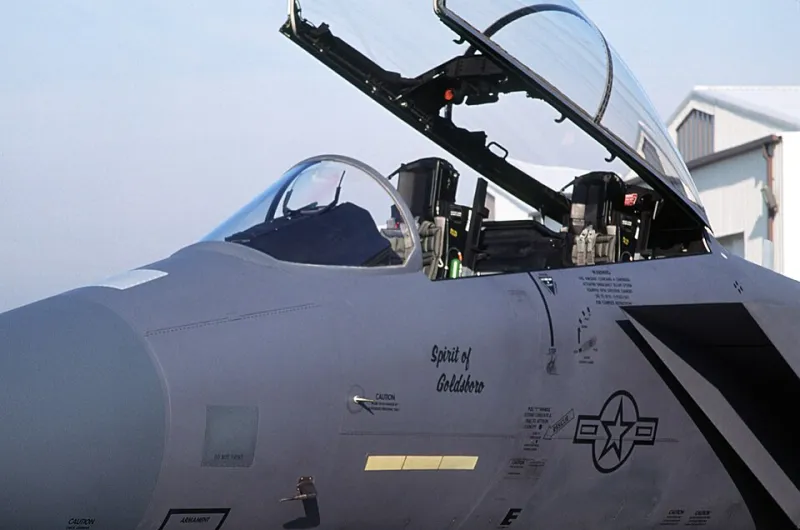
Photo: Department of Defense. American Forces Information Service. Defense Visual Information Center. 1994, Public domain, via Wikimedia Commons
There is a particular kind of military tragedy that receives almost no attention in the histories of air power: the aircraft that was ordered, paid for in part, and never delivered. It leaves no wreckage, no casualty report, and no combat record. It exists only in procurement ledgers, diplomatic cables, and the frustrated memoirs of officers who spent careers waiting for hardware that never arrived. For the Iraqi Air Force, this category of loss is startlingly large — and it tells a story of institutional dysfunction that shaped the service's combat capability as profoundly as any engagement over the Tigris.
The Mirage That Wasn't
By the late 1970s, Iraq had established itself as one of the Arab world's most ambitious military modernizers. Flush with petrodollar revenue and emboldened by Saddam Hussein's consolidation of power, Baghdad pursued a diverse portfolio of Western and Soviet hardware with unusual aggression. Among the most consequential of these efforts was a negotiation with France for an expanded Mirage F1 order that would have included the F1E variant — a multi-role platform with considerably more capable avionics than the interceptor models already in Iraqi service.
The deal stalled repeatedly. French export licensing, influenced by concerns about regional stability and pressure from American and Israeli diplomatic channels, imposed conditions that Baghdad found unacceptable. A portion of the expanded order was eventually restructured, but the full scope of what Iraqi planners had envisioned — a fleet large enough to constitute a genuine multi-role strike force — never materialized. Iraqi pilots who had trained on the F1 were left flying an aircraft whose potential was deliberately constrained by the terms of a procurement that had been quietly gutted at the negotiating table.
Soviet Promises and the Currency of Ideology
The relationship between Baghdad and Moscow was never as stable as Soviet military aid figures suggested. Iraq pursued MiG-29 deliveries with considerable urgency during the mid-1980s, viewing the Fulcrum as a potential equalizer against Iranian F-14 Tomcats still operational after the Shah's fall. Initial deliveries arrived, but the full complement that Iraqi Air Force planners had integrated into their long-term order of battle was never completed.
Political complications within the Soviet Union's own arms export bureaucracy, combined with Iraq's mounting debt from the Iran-Iraq War, repeatedly pushed delivery schedules to the right. By the time the Soviet Union began its terminal decline, the contracts had become nearly unenforceable. Iraq received fewer airframes than it had contracted for, and the maintenance infrastructure that was supposed to accompany the aircraft — technical manuals, spare parts pipelines, and resident Soviet advisors — arrived piecemeal if at all. The result was a MiG-29 fleet that was numerically smaller and operationally more fragile than any war game had assumed.
Post-2003: The Rebuilding Mirage
The collapse of Saddam Hussein's regime in 2003 did not end Iraq's procurement misfortunes — it inaugurated an entirely new chapter of them. The rebuilding of the Iraqi Air Force under American supervision became one of the most documented, and most troubled, defense institution-building efforts of the post-Cold War era. Aircraft were selected, contracts were signed, and delivery schedules were published with optimistic precision. The reality diverged almost immediately.
A planned acquisition of light attack aircraft was delayed by years as debates over capability requirements, contractor performance, and allegations of corruption within the Iraqi Ministry of Defense consumed the program. The Cessna AC-208 Combat Caravan eventually entered service in limited numbers, but the broader light attack fleet that American advisors had envisioned as the backbone of Iraqi close air support capability remained perpetually just beyond the horizon. Meanwhile, Iraqi commanders were left managing an inventory of aircraft that had been selected for political and financial reasons as much as operational ones.
The F-16IQ acquisition, ultimately successful in delivering airframes to Iraqi pilots, was nevertheless shadowed by years of delay, funding disputes, and questions about whether the Iraqi Air Force possessed the institutional infrastructure to sustain a fourth-generation fighter at scale. Those questions were not fully resolved before American advisory support began to contract.
What the Empty Hangars Reveal
The pattern across these failed and fractured procurements is not random. It reflects a set of structural pathologies that persisted through regime change and international intervention alike. Procurement decisions were routinely made on the basis of political relationships rather than operational requirements. Maintenance and sustainment planning lagged years behind acquisition planning. Corruption at multiple levels of the defense establishment diverted resources that were supposed to support training and infrastructure. And the international partners who supplied aircraft frequently had their own incentives — commercial, diplomatic, or strategic — that did not align with Iraq's actual operational needs.
For American planners engaged in post-2003 reconstruction, the lesson was uncomfortable: building an air force is not primarily an aircraft problem. The manifest of undelivered, unflown, and prematurely retired aircraft that accumulated across Iraq's military history is, in the end, a document of institutional failure. Every empty hangar represents not just a missing airframe but a missing chain of training, maintenance culture, doctrinal development, and professional identity that no procurement contract can substitute for.
The ghosts on Iraq's manifest are not simply aircraft. They are the outlines of an air force that never fully became what its planners imagined — and a cautionary register for every nation that believes hardware alone can substitute for the harder work of building the people and systems that make aircraft into weapons of war.