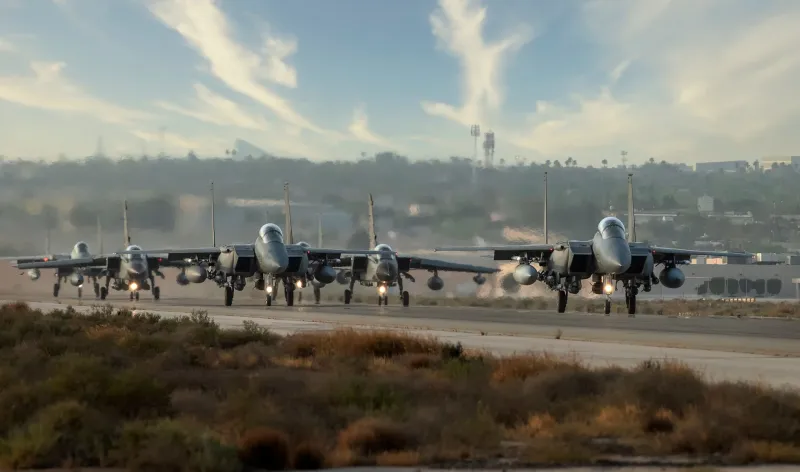
Shock Without Awe: How the Coalition's Opening Air Dominance in 2003 Planted the Seeds of Its Own Strategic Failure
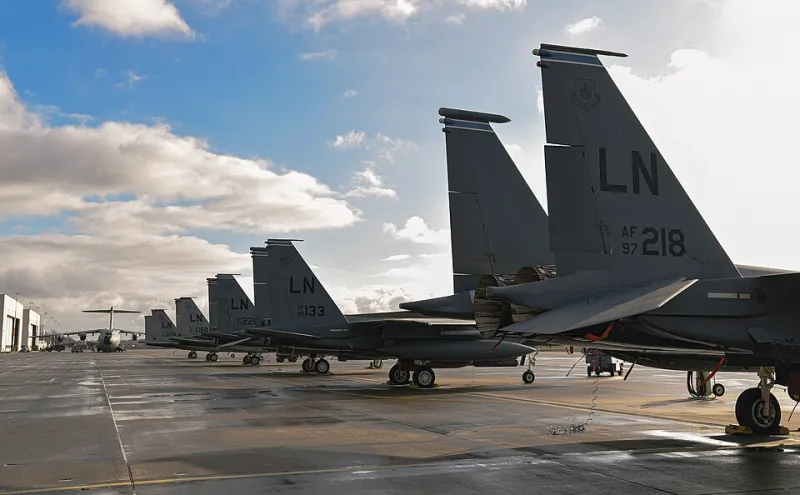
Photo: U.S. Air Force photo by Senior Airman Andrew Alvarado, Public domain, via Wikimedia Commons
There is a particular danger in being right too quickly. When a military campaign opens with the kind of compressed, overwhelming success that Operation Iraqi Freedom's air component achieved in March 2003, the institutional reflex is to treat that success as validation — confirmation that the doctrine, the technology, and the planning were all correct. The harder, more important question — what did we not learn because we won so fast — tends not to get asked until much later, and usually at considerable cost.
This article argues that the air campaign's early dominance in 2003 was not simply a triumph with complications. It was a triumph that actively generated the conditions for subsequent failure by reinforcing assumptions that the campaign's own trajectory would later contradict.
The Metrics That Dazzled
The numbers from the opening phase were, by any historical standard, extraordinary. Coalition aircraft flew thousands of sorties in the campaign's first week with minimal losses to Iraqi air defenses. The Iraqi Air Force — what remained of it after years of attrition, sanctions, and the 1991 campaign — declined to contest the airspace in any meaningful way. Precision munitions struck designated targets with a reliability that exceeded Desert Storm by every quantifiable measure. Baghdad's integrated air defense network, which had been the subject of elaborate suppression planning, collapsed faster than the most optimistic pre-campaign models had projected.
For the officers and analysts who had spent years building the doctrine that produced these results, the opening phase looked like proof. Effects-based operations — the theory that targeting specific nodes in an adversary's system would produce cascading, predictable effects — appeared to be working exactly as advertised. The campaign's architects were, in the spring of 2003, correct.
The problem was not the doctrine. The problem was what the doctrine's early success prevented anyone from examining.
The Assumption Beneath the Assumption
Effects-based operations, as applied in 2003, rested on a foundational premise: that the adversary system being targeted was the relevant adversary system. Coalition planners had built an extraordinarily detailed picture of Iraq's conventional military infrastructure — its air defense networks, its command nodes, its Republican Guard formations, its communications architecture. The targeting process that fed the air tasking order was optimized against that picture.
What the opening air campaign could not target, because it had not been adequately conceptualized, was the distributed, non-hierarchical resistance network that would emerge once the conventional state structure collapsed. Striking a Republican Guard armored division is a tractable targeting problem. Striking a decentralized insurgency that has no fixed nodes, no radar signature, and no air defense to suppress is a categorically different challenge — and the air campaign's early success against the former provided no useful template for the latter.
The institutional confidence generated by the opening phase's results actively discouraged the kind of critical reassessment that might have surfaced this mismatch earlier. When the metrics say you are winning, the organizational pressure to reexamine your assumptions is minimal.
Sustainability: The Invisible Constraint
Beyond doctrinal assumptions, the opening air campaign's tempo created sustainability demands that were not fully visible in the victory metrics. Precision munitions stockpiles that had been built over years were consumed at rates that surprised logistics planners. Certain specialized weapons — particular variants of the JDAM, specific configurations of the HARM anti-radiation missile — were drawn down to levels that created genuine capability gaps within weeks of the campaign's opening.
Aircraft maintainers, whose extraordinary efforts have been documented elsewhere, were sustaining sortie rates that could not be maintained indefinitely without accumulating maintenance debt — deferred inspections, accelerated wear on components, and crew fatigue that safety regulations existed to prevent. The opening phase's operational tempo was achievable precisely because it was finite. The assumption that it could be sustained, or that the campaign would be brief enough that sustainability was irrelevant, proved incorrect on both counts.
The coalition's air logistics infrastructure, designed around a conventional campaign of predictable duration, was not configured for the open-ended counterinsurgency commitment that the post-conventional phase demanded. Adapting that infrastructure required time, resources, and institutional flexibility — all of which were in shorter supply because the opening victory had not prompted their advance preparation.
Coordination Gaps Hidden by Success
The air campaign's early phase also masked coordination problems between air and ground components that would become more consequential as the operational environment grew more complex. In the opening days, the target set was largely pre-planned — fixed installations, identified formations, known infrastructure. The coordination challenge was substantial but manageable within existing joint terminal attack controller capacity and established communication architectures.
As the campaign transitioned to a counterinsurgency environment, the demand for responsive close air support — dynamic targeting against fleeting, time-sensitive threats in complex urban terrain — exposed gaps in the joint coordination system that the opening phase's pre-planned targeting had not stressed. Requests for air support in the counterinsurgency phase were sometimes delayed, misrouted, or declined because the coordination architecture had been optimized for a different kind of fight.
These gaps were not created by the opening air campaign. But the opening campaign's success provided no incentive to identify and address them before they mattered.
What the Victory Prevented
The most significant cost of the opening air campaign's success was the institutional learning it foreclosed. Militaries learn most effectively from failure — from engagements that expose doctrinal inadequacies, equipment limitations, or planning errors under conditions where the consequences are visible and attributable. The 2003 air campaign's opening phase produced very little of that kind of learning precisely because it worked.
The questions that would have been asked if the opening phase had been more contested — Is our targeting framework adequate for a post-conventional environment? Can our logistics sustain an extended commitment? Do our coordination architectures support the full range of missions we may be asked to perform? — were not asked because the opening phase suggested they did not need to be.
By the time those questions became unavoidable, the campaign had already transitioned into a form that the air component's doctrine, logistics, and coordination systems were ill-prepared to support.
The Harder Lesson
None of this diminishes the genuine achievement of the coalition air campaign's opening phase. The pilots, planners, maintainers, and support personnel who executed those opening operations performed at an extraordinary level against a complex and dangerous environment. The results they produced were real.
But military history's obligation is not to celebrate results in isolation. It is to trace the full arc of cause and effect — including the ways in which one kind of success can generate the conditions for a different kind of failure. The 2003 air campaign's early dominance was, in that sense, both its greatest achievement and its most consequential liability.
The shock was real. The awe, it turned out, was premature.