Sand, Sovereignty, and Near-Peer Rivals: How Iraq Forged the Air Force America Flies Today
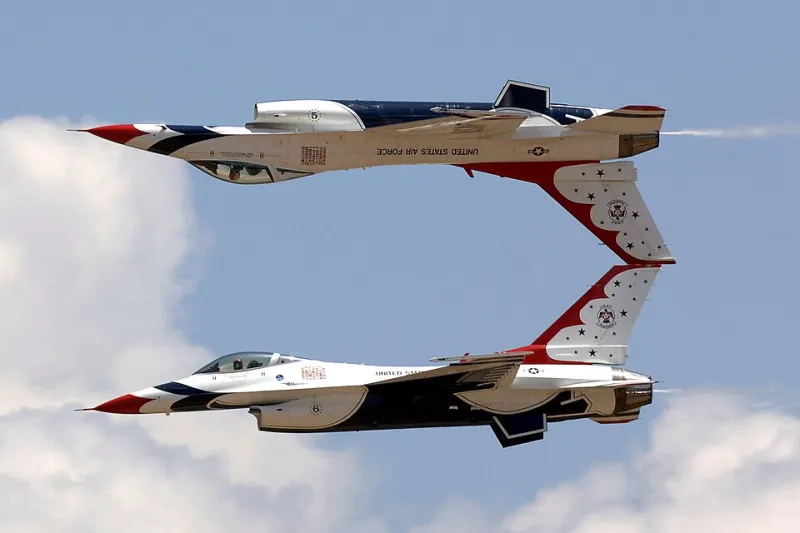
Photo: David Armer, Public domain, via Wikimedia Commons
In the offices where U.S. Air Force doctrine is written and revised, Iraq is not a closed chapter. It is a reference library. The conflicts that unfolded over Iraqi skies from 1991 through the mid-2010s generated a volume of operational data, tactical innovation, and hard-won institutional knowledge that continues to shape procurement decisions, training pipelines, and strategic planning—particularly as American planners turn their attention toward potential confrontations with sophisticated, well-equipped adversaries.
The connection between the deserts of Iraq and the war games being run against notional near-peer opponents is not accidental. It is the result of deliberate institutional effort to translate combat experience into enduring capability.
The Environment as Instructor
No single factor defined the operational environment over Iraq more persistently than the physical environment itself. Sand and fine particulate matter—the infamous Iraqi dust that aviation maintainers still describe with a mixture of respect and profanity—penetrated every system, degraded every surface, and forced a continuous renegotiation of maintenance intervals, filtration standards, and operational expectations.
The F-16's engine inlet filtration system underwent meaningful design refinements that trace directly to Iraq deployment experience. Helicopter operators, particularly those flying rotary-wing platforms in support of ground operations, developed maintenance protocols that were later codified into formal Air Force and Army guidance. The problem of sand ingestion into turbine engines—a challenge that had existed theoretically for years—became an engineering priority with real urgency attached to it because Iraq made the consequences impossible to ignore.
Today, as the Air Force evaluates platforms for potential operations in Middle Eastern, Central Asian, or even Pacific island environments characterized by fine particulate contamination, Iraq-derived filtration and maintenance data sits at the foundation of those assessments.
Coalition Coordination and the Multi-Domain Problem
Iraq was never a unilateral American air operation. From the earliest days of the no-fly zone enforcement through the sustained combat operations of the 2000s, U.S. Air Force planners were required to integrate with allied air forces operating under different rules of engagement, different communication architectures, and different national command authorities.
The friction generated by that coordination challenge was, in retrospect, one of Iraq's most valuable doctrinal gifts. Current U.S. Air Force joint and combined operations doctrine reflects hard-won understanding of how to build interoperability under pressure—how to establish common operating pictures across incompatible systems, how to manage airspace when multiple nations are conducting simultaneous strike, reconnaissance, and refueling operations, and how to maintain tactical coherence when political constraints impose asymmetric restrictions on different coalition partners.
The Combined Air Operations Center model, refined extensively during Iraq operations, is now the organizational template for how the Air Force approaches multi-nation air campaign management. Doctrine officers working on great-power competition scenarios cite CAOC architecture—tested and debugged over years of Iraqi operations—as a foundational element of any credible coalition response to a near-peer challenge.
Precision, Persistence, and the ISR Revolution
The sustained intelligence, surveillance, and reconnaissance operations conducted over Iraq represented something genuinely new in the history of air power: persistent, multi-sensor coverage of a defined battlespace maintained continuously over years rather than hours. The operational patterns, collection priorities, and analytical frameworks developed to support that coverage are now the baseline from which the Air Force builds its ISR doctrine for more contested environments.
The transition from permissive to contested ISR environments is precisely where Iraq's lessons become most pointed. In Iraqi airspace, American reconnaissance platforms operated with relative freedom. Against a sophisticated adversary with modern integrated air defense systems, that freedom disappears. But the analytical tradecraft, the sensor fusion techniques, and the targeting cycle refinements developed over Iraq still apply—they simply require different platform survivability assumptions.
The Reaper and Predator programs matured operationally over Iraq in ways that permanently altered Air Force thinking about persistent surveillance and remote strike. Current procurement interest in low-observable unmanned platforms for contested environments is, in a direct institutional lineage, a response to the question Iraq raised: what happens when the airspace is no longer permissive enough for the platforms we built our ISR architecture around?
Electronic Warfare and the Frequency Landscape
Iraq's air defense network, though ultimately overmatched, presented American electronic warfare crews with a sophisticated and adaptive challenge. Iraqi operators demonstrated a willingness to modify emission patterns, shift frequencies, and use radar in ways that complicated American detection and jamming operations. The cat-and-mouse dynamics of that contest generated electronic warfare doctrine that is now applied in training exercises against far more capable simulated threats.
The Air Force's electronic warfare community points to Iraq as the environment where passive detection techniques were elevated from supplementary tools to primary collection methods. When active jamming draws a radar-guided missile, passive listening becomes the preferred approach. That operational preference, field-tested over Iraqi airspace, is now embedded in crew training and platform design requirements.
The Doctrine Officers Speak
Conversations with current Air Force doctrine officers—conducted under conditions that preclude direct attribution—reveal a consistent theme: Iraq is treated not as a historical curiosity but as an active case study that informs current planning against sophisticated adversaries.
One officer described the Iraq experience as having established what he called a "friction baseline"—a documented understanding of how air operations actually degrade under real-world conditions of weather, maintenance pressure, coalition politics, and enemy adaptation. That baseline, he argued, is what separates realistic planning from theoretical modeling.
Another characterized the multi-coalition coordination challenges of Iraq as the most underappreciated legacy of that conflict. The ability to manage alliance relationships under operational pressure, to maintain shared situational awareness across incompatible national systems, and to preserve tactical coherence when political constraints create asymmetric limitations—these are skills that atrophy without practice, and Iraq provided decades of practice.
The Proving Ground That Keeps Teaching
The U.S. Air Force that would be called upon to operate in a contested, near-peer environment today is not the force that flew into Iraqi airspace in 2003. It is more capable, more technologically sophisticated, and more doctrinally mature. But the doctrinal maturity it carries is, in substantial measure, a product of what Iraq taught.
Sand in the engine inlets. Coordination failures at the CAOC. Radar operators who adapted faster than expected. Maintenance cycles that collapsed under desert heat. Each of those experiences left a mark on the institution. The Air Force that studies great-power competition today does so with Iraq's lessons written into its foundational documents—not as a monument to past campaigns, but as working guidance for the conflicts it has not yet fought.