Signals Turned Against Themselves: How American Electronic Warfare Officers Weaponized Iraq's Own Air Defense Networks
In every air campaign over Iraq — from the opening salvos of Desert Storm in January 1991 through the sustained operations of the years that followed — the contest for electromagnetic superiority was as consequential as any dogfight or bombing run. While the public imagination tends to fix on streaking jets and exploding targets, a quieter and arguably more decisive war was being fought in the invisible architecture of radar pulses, radio frequencies, and surface-to-air missile guidance signals. The men and women who waged that war carried no guns. Their weapons were electrons.
Electronic Warfare Officers — known within the community simply as EWOs — occupied the back seats of aircraft like the F-4G Wild Weasel, the EA-6B Prowler, and later the EA-18G Growler, their eyes fixed not on the horizon but on threat-display screens alive with signal data. Their mission was never simply to jam. Jamming, in the parlance of the community, was a blunt instrument — useful, necessary, but limited. The more sophisticated objective, the one that defined the highest tier of electronic warfare operations over Iraq, was manipulation: convincing enemy systems not that they were being jammed, but that everything was functioning normally, while the information those systems were processing had been quietly and comprehensively falsified.
The Architecture of Iraqi Air Defense
To understand what American EWOs accomplished, one must first appreciate the system they were working against. Iraq's Integrated Air Defense System, known as KARI — an acronym derived from the French transliteration of Iraq — was among the most sophisticated networks in the Middle East at the outset of Desert Storm. Designed with Soviet technical assistance and supplemented with French and Chinese components, KARI linked early-warning radars, surface-to-air missile batteries, anti-aircraft artillery, and fighter interceptor units through a centralized command infrastructure headquartered in Baghdad.
The system was designed to be redundant and layered. Knocking out a single radar node was not enough; the network was built to absorb localized damage and continue functioning. Coalition planners understood from the outset that dismantling KARI would require not just physical destruction but systemic disruption — attacking the nervous system, not merely the muscle.
Deception at the Speed of Light
The most classified dimension of American electronic warfare over Iraq involved techniques that remain, even decades later, only partially declassified. What is known — through declassified after-action reports, congressional testimony, and the accounts of former practitioners — is that coalition EWOs developed the capability to inject false radar returns into Iraqi air defense networks. Rather than simply denying Iraqi operators the ability to see, these techniques allowed American crews to control what Iraqi operators believed they were seeing.
The practical consequences were significant. Iraqi surface-to-air missile batteries that believed they were tracking a genuine target could be induced to expend their missiles against phantom aircraft — burning through limited stockpiles of surface-to-air missiles while coalition strike packages proceeded unmolested on entirely different headings. Iraqi command centers receiving synthesized radar imagery might redirect fighter interceptors toward empty sky, clearing corridors that actual strike aircraft then exploited.
This was not mere jamming. It was electronic puppetry — using the enemy's own infrastructure as a stage for a performance scripted in Washington and rehearsed at classified facilities across the continental United States.
The Men Behind the Screens
EWOs who flew these missions came from a narrow pipeline. Selection emphasized mathematical aptitude, systems reasoning, and an unusual capacity for situational awareness in an environment defined by abstraction. A pilot navigates by landmarks and instruments; an EWO navigates by signal signatures, frequency hopping patterns, and the behavioral quirks of specific radar models. The SA-2 Guideline and SA-6 Gainful systems that formed the backbone of Iraqi air defenses each had distinct electromagnetic personalities — characteristic pulse repetition frequencies, scan rates, and acquisition behaviors that experienced EWOs could identify and exploit almost instinctively.
Former EWOs who have spoken on the record describe the experience in terms that blend the technical with the psychological. Understanding how an Iraqi radar operator would interpret a particular signal environment required understanding not just the equipment but the doctrine, the training, and the cognitive habits of the men sitting at those consoles in Baghdad and Basra. Electronic warfare, at its highest level, is as much a study in human behavior as it is in physics.
The EA-6B Prowler and Its Successors
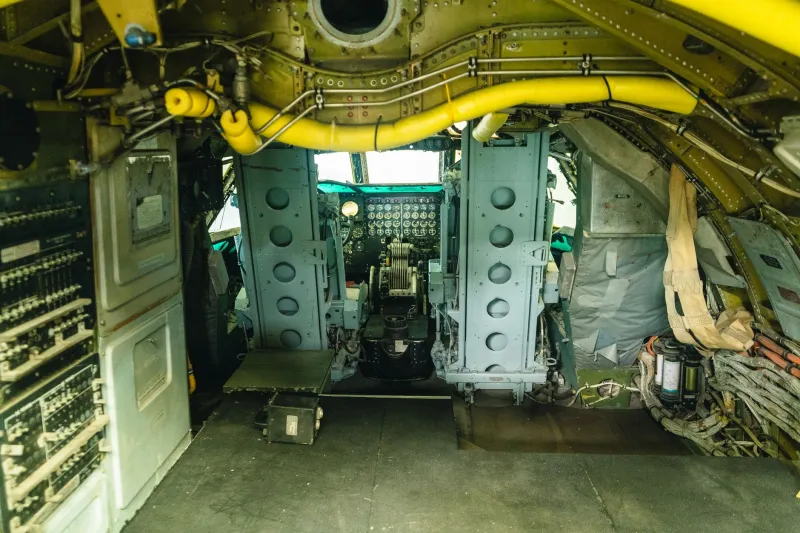
No aircraft better embodied the American commitment to electromagnetic dominance over Iraq than the EA-6B Prowler. Operated by the United States Navy and Marine Corps, the Prowler carried a crew of four — one pilot and three EWOs — and was equipped with the AN/ALQ-99 Tactical Jamming System, a modular suite capable of covering an exceptionally wide range of frequencies simultaneously. During Desert Storm and the subsequent enforcement of northern and southern no-fly zones, Prowlers flew as the electromagnetic shield for every major strike package operating over Iraqi territory.
The aircraft's ability to not merely jam but to characterize, record, and selectively respond to specific radar emissions gave coalition planners a degree of flexibility that Iraqi air defense commanders could not have anticipated. As the years of no-fly zone enforcement stretched from months into a decade, American EWOs accumulated an encyclopedic understanding of Iraqi air defense behavior — cataloguing every frequency shift, every procedural adaptation, every attempt by Iraqi operators to defeat coalition jamming through technical modification.
That accumulated knowledge did not sit idle. It fed directly into the planning for Operation Iraqi Freedom in 2003, where the KARI network, already degraded by years of attrition and economic sanctions, faced an electronic warfare campaign informed by more than a decade of continuous observation.
A Legacy Written in Frequencies
The legacy of American electronic warfare over Iraq extends well beyond the operational outcomes of any single campaign. The techniques refined in Iraqi airspace — particularly the manipulation of integrated air defense networks to generate false situational pictures at the command level — have become foundational concepts in contemporary electronic warfare doctrine. Adversaries who study American air campaigns closely, as China and Russia demonstrably do, have invested heavily in developing countermeasures and analogous capabilities of their own.
For the EWOs who flew those missions, however, the legacy is more personal. They operated in a domain that received little public recognition precisely because their successes were, by definition, invisible. No bomb damage assessment photograph captures a missile battery that was tricked into firing at empty air. No gun camera footage documents a command center that spent an entire night reacting to an air raid that never existed.
Their victories were written in frequencies, not fire — and that, perhaps more than anything else, explains why their story has taken so long to reach the audience it deserves.