What the Sky Looked Like From Below: Iraqi Civilian Voices and the Aerial War They Survived
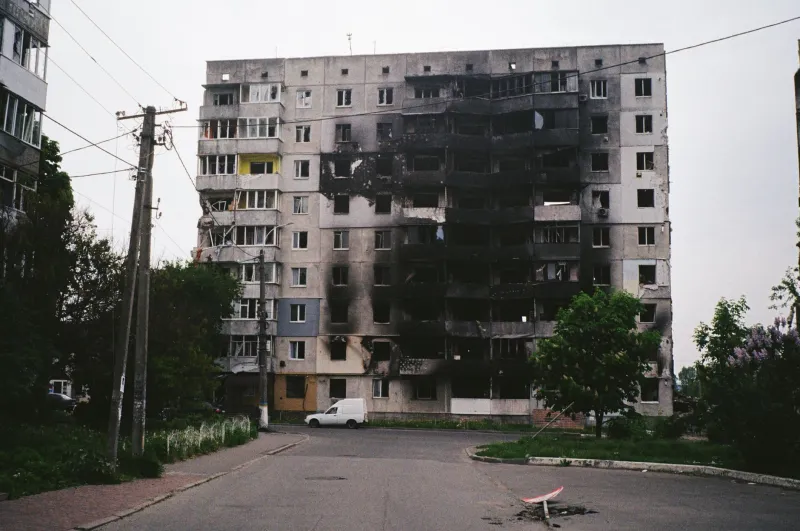
The official record of America's air campaigns over Iraq is, by any measure, extraordinarily detailed. Mission logs, bomb damage assessments, sortie counts, and targeting coordinates fill thousands of declassified pages held in archives from Washington to Riyadh. What those documents almost never contain is the sound of a mother pressing her children to a concrete floor, or the particular silence that settles over a neighborhood after a building three streets away ceases to exist. That silence—and everything it contains—belongs to a different kind of history.
Over the past two decades, a scattered but growing body of oral history work has attempted to recover exactly that record. Conducted by academic researchers, documentary filmmakers, humanitarian organizations, and a handful of independent journalists, these projects have gathered testimonies from Iraqi civilians who lived through the 1991 Gulf War, the decade of enforcement operations that followed, and the 2003 invasion and its aftermath. Taken together, their accounts constitute an archive that sits in uncomfortable tension with the precision narratives that have long dominated American discussions of air power.
The Gap Between the Cockpit and the Street
American military culture has invested heavily in the concept of precision. The development of laser-guided munitions, GPS-aided bombs, and real-time intelligence feeds was driven in part by a genuine desire to reduce civilian harm. Briefing slides and press conferences during both Gulf conflicts emphasized accuracy statistics and the surgical nature of coalition strikes. For pilots and planners operating at altitude, those statistics were real and meaningful.
For the people living in Baghdad's Karrada district, or in the agricultural towns along the Euphrates corridor, or in the densely populated neighborhoods surrounding Basra, precision was an abstraction they had no way to access. What they experienced was concussive overpressure, the disorientation of sudden darkness when power infrastructure failed, and the slow-building dread of not knowing when or where the next strike would fall. Several oral history collections, including work compiled by the University of Michigan's Iraq Memory Foundation and testimonies gathered by Human Rights Watch researchers in the early 2000s, document this perceptual gap with striking consistency.
One recurring theme across dozens of accounts is the way sound itself became a primary instrument of psychological impact. Survivors describe learning to distinguish between the high, thin whistle of an incoming munition and the lower rumble of distant ordnance. They describe the particular quality of silence after a strike—a silence described by multiple witnesses as physically heavy, as though the air itself had changed composition. Several accounts note that children stopped speaking for days after particularly intense bombardment periods, a detail that appears in testimonies from both 1991 and 2003.
Memory, Meaning, and the Limits of Documentation
Oral history is, by its nature, imperfect as documentary evidence. Memory reconstructs rather than records. Trauma reshapes chronology. Political context influences what survivors choose to emphasize and what they prefer to leave unspoken. Researchers who have worked extensively with Iraqi civilian testimonies are candid about these limitations.
What oral history does uniquely well, however, is preserve the texture of lived experience in ways that quantitative records cannot. A bomb damage assessment can confirm that a particular facility was destroyed on a particular date. It cannot explain what it meant to the family that had lived next door for thirty years, or how a neighborhood recalibrated its sense of safety—or abandoned it entirely—in the weeks that followed.
Dr. Dina Rizk Khoury, a historian whose work on modern Iraq has engaged extensively with civilian memory, has noted that Iraqi oral accounts of the aerial campaigns frequently organize events not by calendar date but by sensory landmark: the night the lights went out and never came back on, the morning the sound changed and stayed changed. This alternative chronology, she argues, is not a failure of recollection but a different and legitimate way of understanding what happened—one that complements rather than contradicts the official record.
What Precision Looks Like at Ground Level
Several testimonies gathered after the 2003 campaign are particularly instructive for understanding the gap between intended and experienced effect. Coalition planners went to considerable lengths to avoid striking civilian infrastructure directly, and by the metrics of military targeting, many operations were executed with genuine accuracy. Yet the interconnected nature of urban systems meant that strikes on power generation, communications nodes, and transportation links produced cascading effects that were experienced as total rather than surgical.
Survivors from Baghdad's western districts describe a period in the spring of 2003 during which the neighborhood existed in a kind of suspended state—power intermittent, water pressure unreliable, the sound of aircraft a constant presence overhead. The strikes themselves, when they came, were often distant. But the cumulative effect of living inside a contested airspace, uncertain about where the next impact would occur and unable to predict the rhythm of operations, produced a form of sustained stress that witnesses consistently describe as more debilitating than the physical destruction itself.
This phenomenon—the psychological weight of ambient aerial presence—appears repeatedly in testimonies from 1991 as well. The extended air campaign that preceded the ground war lasted thirty-eight days. For civilians in targeted areas, that duration produced what some researchers have characterized as a form of chronic threat response, a state of perpetual alertness that outlasted the conflict itself by years.
Preserving What the Archives Miss
The organizations working to document these civilian experiences face challenges that go beyond the usual difficulties of oral history methodology. Many Iraqi witnesses are scattered across a diaspora that spans Jordan, Sweden, the United Kingdom, and communities throughout the United States. Others remain in Iraq, where the political climate has at various points made candid discussion of the war years complicated or genuinely dangerous. Some potential witnesses have died. Others have chosen silence.
What survives is fragmentary but irreplaceable. The Iraq Memory Foundation's audio and video archive, which now holds thousands of hours of testimony, represents perhaps the most comprehensive effort to preserve this record in a form accessible to future researchers. Similar projects have been undertaken by the Oral History Association and by documentary filmmakers whose work has reached American audiences through public broadcasting and festival distribution.
For readers accustomed to thinking about Iraq's aerial campaigns through the lens of aircraft performance, weapons systems, and operational outcomes, these civilian accounts offer something genuinely disorienting: a version of the same events in which the dominant experience is not capability but vulnerability, not precision but uncertainty, not victory but endurance. Both versions are true. The history of aerial warfare over Iraq is incomplete without them.
The sky looked very different from below. Understanding that difference is not a challenge to the valor of the men and women who flew those missions. It is, rather, the fullest possible accounting of what those missions meant—and what they cost.