Zero Visibility, Zero Margin: How Iraq's Haboobs Forced a Revolution in American Air Tactics
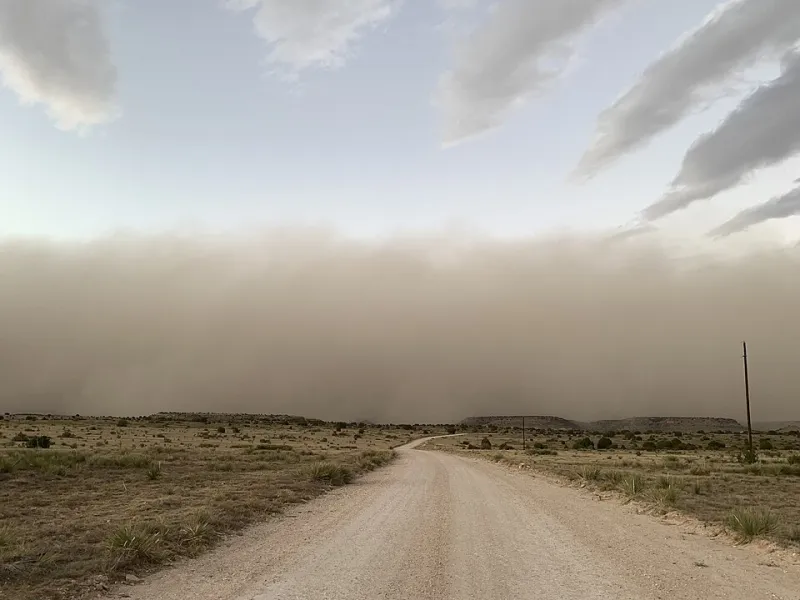
Photo: OKJaguar, CC BY-SA 4.0, via Wikimedia Commons
The briefings before Operation Iraqi Freedom described a campaign built on precision. Laser-guided munitions, GPS-aided weapons, synthetic aperture radar, and the most sophisticated sensor fusion architecture ever assembled for a military operation would, in theory, allow coalition aircraft to locate, identify, and engage targets with near-clinical efficiency. What the briefings did not adequately account for was the haboob — the massive, opaque wall of suspended dust that periodically engulfs Iraq's central plains with the indifference of a geological force and the tactical consequences of a strategic weapon.
The Anatomy of a Haboob
A haboob is not a dust storm in the conventional sense. It is a convectively driven phenomenon, typically generated by the outflow boundary of a collapsing thunderstorm cell, which lifts enormous quantities of fine particulate matter from Iraq's alluvial soils and drives them horizontally across the landscape in a front that can extend hundreds of miles and rise to altitudes exceeding five thousand feet. The particles involved are not the coarse sand of popular imagination but ultrafine silt — material that penetrates engine intakes, coats optical sensors, and reduces visibility to near zero within minutes of a front's arrival.
For aviation, the consequences are layered. At low altitude, rotor wash from helicopters creates localized brownout conditions that are operationally distinct from the haboob itself but frequently compound its effects. At medium altitude, the suspended particulate degrades electro-optical and infrared sensors dramatically, reducing the effective range of targeting pods to a fraction of their designed performance. At high altitude, the upper reaches of a major haboob can affect even fixed-wing aircraft operating above the storm's primary mass, introducing turbulence and sensor noise that complicate targeting solutions.
March 2003: When the Storm Arrived
The haboob that struck coalition forces in late March 2003 — arriving just days into Operation Iraqi Freedom — became one of the most consequential meteorological events in the history of American air power. A massive storm system swept across southern and central Iraq, grounding helicopter operations, severely degrading fixed-wing sensor performance, and creating conditions that effectively suspended the ground campaign's momentum for nearly two days.
The timing was operationally significant. Coalition ground forces were advancing on multiple axes toward Baghdad, and close air support was the connective tissue holding the operation's tempo together. When the storm arrived, that support contracted sharply. Aircraft that remained airborne found their targeting systems struggling to acquire and track vehicles through particulate concentrations that overwhelmed electro-optical sensors. GPS-guided weapons retained some utility — their guidance is not optically dependent — but the terminal identification of targets, the confirmation that the object being engaged was in fact a hostile military vehicle and not a civilian truck, became extraordinarily difficult.
Controllers and pilots improvised. Aircraft were repositioned to higher altitudes where sensor performance was marginally better. Mission profiles shifted toward pre-planned strikes against fixed infrastructure targets whose coordinates were already loaded and verified, rather than the dynamic close air support that advancing ground forces needed most. It was a rational adaptation, but it represented a significant departure from the campaign's design assumptions.
Meteorological Intelligence as a Warfighting Discipline
The 2003 storm accelerated a transformation in how American air planners regarded weather intelligence. Before Iraq, meteorological support for air operations was well-developed but largely focused on flight safety and mission planning windows — the question of whether conditions were good enough to fly. After Iraq, the question evolved into something more operationally sophisticated: how does specific atmospheric data affect the performance of specific sensor systems against specific target types, and how should that analysis drive weapons selection, approach geometry, and mission timing?
This reframing elevated the role of weather officers from mission-support specialists into participants in the targeting process itself. Understanding that a haboob's particulate density at a given altitude would reduce a targeting pod's effective range to a specific distance was not merely a flight safety calculation — it was a weapons employment variable that affected the probability of mission success and the risk of civilian casualties from misidentified targets.
The Defense Department invested in improved atmospheric modeling tools in the years following the 2003 campaign, with particular attention to the behavior of suspended particulate in arid environments. The goal was to provide air planners with predictive data specific enough to inform weapons selection before aircraft were even airborne — to know, hours in advance, that a haboob developing over western Iraq would reach a given target area at a given intensity by a given time, and to plan accordingly.
Adapting the Formation
At the tactical level, pilots and controllers developed a set of adaptive practices for operating in degraded visibility conditions that would have been unfamiliar to the Desert Storm generation. Formation integrity in haboob conditions required greater reliance on instrument flight and data link position information rather than visual reference. Approach geometries for close air support were modified to reduce the time aircraft spent in the most heavily particulate-laden altitudes, accepting some reduction in targeting time in exchange for better sensor performance during the critical engagement window.
The A-10 Thunderbolt II community, whose pilots operated at altitudes where haboob conditions were most severe, developed informal procedures for communicating sensor degradation status to ground controllers in real time — a practice that allowed controllers to make more informed decisions about which aircraft to task against which targets when conditions varied across a sector. It was the kind of bottom-up doctrinal evolution that combat environments generate when formal procedures have not kept pace with operational reality.
The Atmosphere as Adversary
Iraq's haboobs did not defeat American air power. But they complicated it, constrained it, and forced a generation of planners, pilots, and intelligence officers to reckon with a category of adversary that no amount of technological investment can fully neutralize. The atmosphere over Iraq was not a neutral medium through which aircraft passed. It was a dynamic, unpredictable environment that imposed its own operational logic on every campaign conducted within it.
The adaptations that American air power made in response to Iraq's most punishing weather events represent a genuine evolution in the discipline — one that is less visible than a new aircraft type or a new weapons system but no less consequential. The haboob taught the coalition that precision is a function not just of technology but of environment, and that the most sophisticated air campaign in history remains subject to the oldest and most indifferent of forces: the wind, the dust, and the sky.