Bleached Wings: The Slow Death of Iraq's Abandoned Military Aircraft
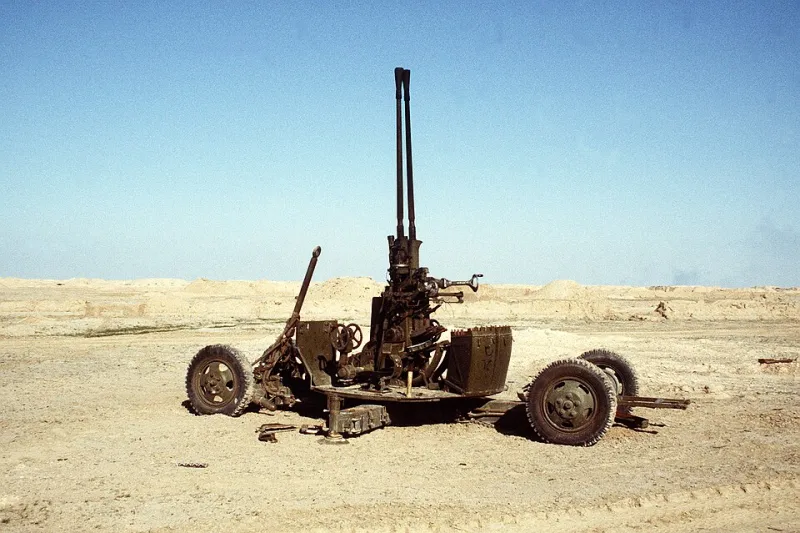
Photo: Staff Sgt. Guadalupe Hernandez, Public domain, via Wikimedia Commons
The photographs that emerged from Iraqi air bases in the weeks following the 2003 invasion told a story that surprised even experienced military aviation analysts. Across remote desert strips and the margins of larger operational airfields, rows of military aircraft sat exposed to the elements — MiG-21s, MiG-25s, Su-22s, and a scattering of Western-origin types acquired before the 1990 embargo — their paint oxidized to a uniform pale gray, canopies cracked or missing entirely, tires flat against the crumbling concrete of dispersal pads that had not seen maintenance crews in years.
These were not aircraft destroyed in combat. They were aircraft that had simply been left to die.
The Sanctions Economy of Aircraft Abandonment
Understanding why Iraq's military aircraft ended up scattered across open-air boneyards requires understanding the economic and logistical catastrophe that United Nations sanctions imposed on the Iraqi Air Force after 1990. Prior to the Gulf War, Iraq operated one of the largest and most diverse air forces in the Middle East, drawing on Soviet, French, Chinese, and even some American-origin equipment. That diversity, which had once been a point of institutional pride, became a maintenance nightmare the moment international sanctions severed Iraq's access to spare parts, technical documentation, and foreign technical advisors.
The problem was not uniform across the fleet. Aircraft types for which Iraq had accumulated significant domestic spare inventories — certain MiG-21 variants, for instance — remained flyable longer than types that depended on continuous external resupply. But by the mid-1990s, the attrition was visible at every major Iraqi air base. Unserviceable aircraft were stripped of usable components to keep flyable examples in the air, a process of institutional cannibalization that left the donor airframes as hollow shells.
The decision about where to leave these stripped hulks was not always systematic. Some were pushed to the edges of active dispersal areas. Others were towed to remote corners of airfield perimeters where they would not obstruct flight operations. A smaller number were deliberately positioned in patterns that, viewed from satellite or reconnaissance aircraft, might suggest operational activity — a deception measure that complicated coalition targeting assessments in ways that were only fully understood after ground forces arrived.
What Coalition Forces Found
American and British military personnel who entered Iraqi airfields in April and May of 2003 were prepared to find damaged infrastructure. They were less prepared for the scale and condition of the aircraft graveyards awaiting them.
At Tallil Air Base in southern Iraq, coalition forces documented dozens of aircraft in varying states of deterioration arranged across dispersal areas that had clearly not been active for years. Sand had drifted against landing gear assemblies, in some cases burying wheel assemblies entirely. Engine intake covers — where they existed at all — had been improvised from canvas or sheet metal rather than manufactured components. At several aircraft, the cockpit areas had been stripped of avionics and instrumentation, the wiring harnesses removed and presumably used elsewhere.
At Al-Bakr Air Base, a site with particular historical significance as a hub of Iraqi Air Force operations, coalition engineers found a collection of MiG-25 airframes in a condition that generated considerable professional interest. The MiG-25 — known to NATO as the Foxbat — had been a source of significant intelligence fascination since a Soviet pilot defected to Japan with one in 1976. The Iraqi examples, though stripped and deteriorated, provided Western analysts with additional data points on late-production variants and Iraqi-specific modifications.
The physical condition of the aircraft revealed information that went beyond the hardware itself. Maintenance logs, where they could be recovered from cockpit areas or nearby facility buildings, documented the progressive degradation of the fleet in granular detail. Entries recording repeated deferral of required inspections, substitution of non-standard components, and the cannibalization of specific aircraft to support others painted a portrait of an air force fighting a losing battle against entropy.
Reading Readiness in Rust
For Western military aviation analysts, the condition of Iraq's abandoned aircraft provided a form of ground truth that was difficult to obtain through remote observation alone. Pre-war intelligence assessments of Iraqi air force readiness had relied heavily on signals intelligence, overhead imagery, and the accounts of defectors — sources that were individually valuable but collectively incomplete.
The physical evidence at Iraqi airfields confirmed what the most pessimistic pre-war assessments had suggested: that the operational Iraqi Air Force of 2003 was a fraction of the paper order of battle that official estimates cited. The number of aircraft actually capable of sustained combat operations was dramatically lower than the total inventory suggested, because a large portion of that inventory existed only as deteriorating hulks that had not been flyable for years.
This finding had immediate implications for how coalition planners assessed the air threat they had faced — and retroactively reframed some of the decisions made during the 2003 air campaign. Strike sorties allocated to airfield suppression, based on assessments of Iraqi aircraft that might contest coalition air superiority, were in some cases directed at facilities where no flyable aircraft remained. The threat, in these instances, had already eliminated itself through neglect.
Salvage, Science, and Institutional Learning
Not all of Iraq's abandoned aircraft were left to continue their dissolution. A selection of airframes — particularly those of types with ongoing intelligence value — were recovered by coalition forces for more detailed examination. Some were transported to facilities outside Iraq for technical analysis. Others were assessed in place by specialized exploitation teams who documented construction details, avionics configurations, and maintenance practices before the airframes were disposed of.
The salvage process also recovered a significant quantity of documentary material from airfield facilities — technical manuals, maintenance records, pilot training documents, and operational planning materials that provided insight into how the Iraqi Air Force had functioned during its years of isolation. These materials complemented the physical evidence of the aircraft themselves, together constituting a detailed record of institutional decline.
For American military aviation, the Iraqi boneyard experience reinforced a principle that logistics and sustainment professionals had long argued: that an air force's combat capability is ultimately constrained not by the number of aircraft it possesses, but by the number it can maintain in flyable condition. Iraq had learned this lesson the hard way. The bleached wings scattered across its desert airfields were the evidence.
They were also, in a more immediate sense, a warning. Any adversary subjected to sustained economic pressure and denied access to the global supply chains that modern military aviation depends upon would face the same trajectory. The rust that consumed Iraq's aircraft did not discriminate by type or origin. It followed the maintenance gap wherever that gap appeared.